By RJ on 29 January 2023.
.jpg)
I love being able to customize my character in games of all sorts. In tabletop roleplaying games, I love the freedom to describe my minotaur blackguard as a hulking, eight-foot-five-inches tall, grizzled beast of snow-white fur and curled blood-red horns. In video games such as Path of Exile, I enjoy the ability to create a build unlike any other, worming my way through a seemingly limitless skill tree while collecting terrific and terrible pieces of gear. In virtual reality games like Beat Saber, it's great I'm able to choose what I want to play when I want to play it without any bindings on my arms or blocks in my path.
It's also important the choices we as players make about our characters matter. What our characters say to the vampire queen should have an effect. What magic items our characters wield should turn the tides of the battle or play a key role in the story. How we build our characters, mechanically, or what we choose to be, should be important. These choices shouldn't be meaningless.
Presently, Orrery is built on three fundamental design pillars, which I promise are not mere buzzwords: deep character customization, simply powerful rules, and improvisational freedom. Each interweaves with the next.
My in-development tabletop roleplaying game absorbs elements from various systems, tabletop and not. In some cases, directly, unedited. The rest of the swiped mechanics and ideas? Altered for the better. A few examples include Path of Exile's skill tree, Pathfinder 2E's action point system, and 5E's addition of advantage and disadvantage.
Altogether, every element aims to support each design pillar.
Let's begin this series of articles discussing Orrery's design with an inspection of the first design pillar: deep character customization.
RJD20's Patreon
If you would like to see bits and pieces of Orrery as it develops, become a patron on Patreon for a $1 per month or more. In addition to regular Friday drops of expanding Orrery playtest content, you receive exclusive access to 5E-compatible extras like Character Class Foe Generators, inspirational villain ideas, and insight into my home games you won't find anywhere else!
Every coin of assistance helps. Thank you for your support.

Player Characters are the Heart of Every Game
The player characters are indisputably the most vital part of any successful game system. If character design isn't appealing to a wide audience, the game won't be enjoyable. It will fail.
Orrery's character creation and constant customization help build compelling characters for everyone.
In Orrery, players choose a definitive ancestry, an inspiring background, and a unique path through the Orrery for their character. During play, each aspect evolves, and new mechanics take hold, like artifacts and boons. However, it all begins with character creation.
The Importance of Ancestry in Orrery
Character ancestry in Orrery determines a character's appearance and provides typical points of origin in the world. While exceptions and oddities exist, Orrery provides plenty of inspiration for players with typical descriptions.
In addition, every ancestry provides a powerful passive and/or active ability to a character.
While not as strict as other games, Orrery places emphasis on your character's chosen ancestry, unlike the current iteration of 5E.
The human ancestry includes +3 to all ability scores, while the halfling ancestry grants a strong ability to fight the Feared condition, an optional dinosaur companion, and +2 to Constitution. Both also detail typical regions and settlements frequented by each, a brief history of the ancestry in the setting, and what they typically look like.
Orrery's section on ancestry stresses that while appearance and point of origin may vary greatly from individual to individual, ancestral bonuses and abilities do not. When a player chooses an ancestry for their character, it means more than appearance. It affects their character for the rest of its life in the game and world.
Choosing a character's ancestry is an important choice, not meaningless or pure flavor.
Setting Up the Board with Background in Orrery
Backgrounds in Orrery are cloud-piercing mountains of inspiration. They are also hyper-focused on setting up a character's place in the world, what their initial goals are, and how they are connected to the other characters in the group.
There are oodles of roll tables. Plus, each background gives out a slightly randomized set of items, so no two Soldiers or Merchants ever start off with identical inventories.
This game's backgrounds address a major problem I see in other games with similar backstory creation systems. It also tries to help those who love crafting their character's own history but forget to connect it to the story at hand.
Each background includes a snippet of inspiration about a character's former profession, interesting traits they might have as a result, a good reason why they are adventuring now, and a couple sample goals. None of the roll tables or snippets need to be used verbatim, though they can be. Instead, players can use them to set the board their character once played on and the board they will play on in the future.
In order, the pieces of a background in Orrery are:
- The background itself
- Quirks
- Core Beliefs
- Ties
- Motivations
- One background-specific aspect
- Equipment and bonuses

For example, the Sailor background in Orrery inspires the player to think about their character's final voyage as a sailor. Where did they go? What happened? Why was this their final voyage? Is this what caused them to pursue life as an adventurer?
In addition, it provides information on what sailors typically do in the game's setting, sample personality traits, and randomized equipment all characters with a Sailor background can roll to obtain before the real game begins.
Crafting a Unique Class with the Orrery
Once a character's ancestry is chosen and their background outlined, they begin their journey through the vast Orrery, the RPG's namesake.
The Orrery is a skill tree. Presently, every character paths through the same Orrery, but that may change in future iterations of the game. Passive nodes called orbs grant minor passive bonuses to characters, while passive and active nodes called keystones grant characters powerful, varied abilities. They define a character. Other nodes do exist, but we will explore them at a later date.
Depending on a character's path in the Orrery, they can be a warrior who wades into battle and defends the weak, a raging berserker who hits little but whose hits deal massive damage, or a fighter who can home in on their foes and annihilate them with perfect focus. Eventually, a character could merge all three of these playstyles, becoming the pinnacle of their domain in the setting. They might even rush toward a certain keystone and then look for a portal node, which can take them to a completely different area of the Orrery. A warrior-centric character might portal into the magic-user sphere, or a gunslinger path character may portal into the divine sphere of the Orrery. The possibilities are numerous.
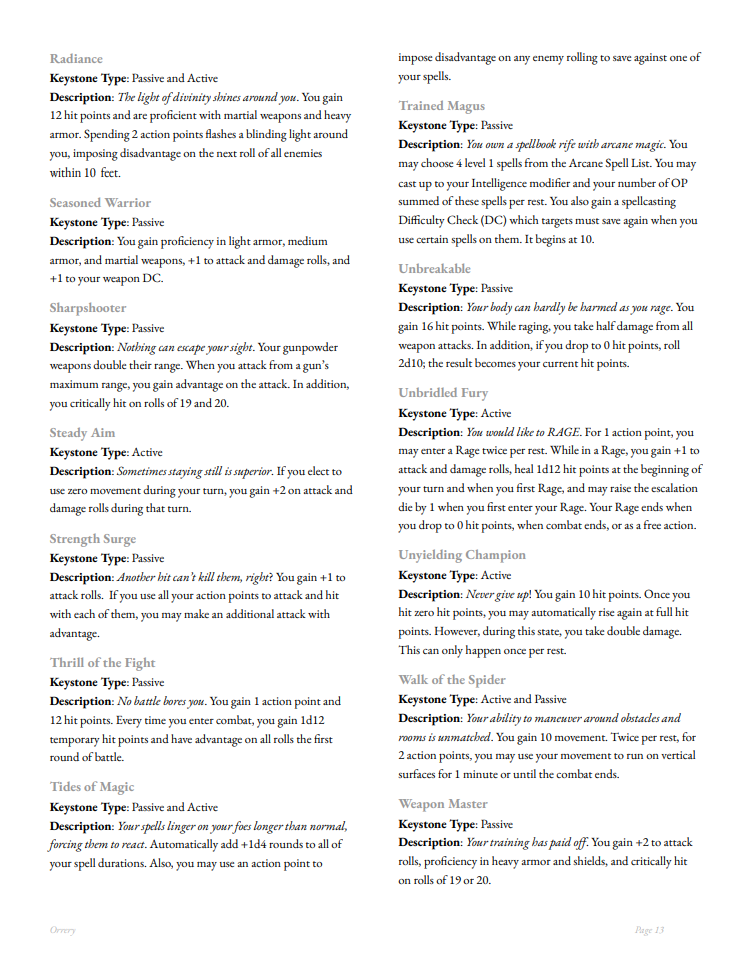
Here are a few keystones found across the Orrery:
Ancestral Bonds
Keystone Type: Active
Description: The spirits of your ancestors connect you to another when you rage. You gain 6 health points and +1 armor class. When you enter Rage, you may pool your health points with one other creature. All damage dealt to either you or the creature affects the pool. Once it hits zero, you both suffer the effects of hitting zero. This effect ends when combat ends or you choose to end it with an action point.
Explosive Surprise
Keystone Type: Active
Description: Not all bullets merely pierce. On a hit with a gunpowder weapon, using an additional action point causes your damage to spread to all creatures within 5’ of your target.
Mighty Blows
Keystone Type: Active, Passive
Description: Your rage strengthens your weapon like nothing else. While raging, you critically hit on rolls of 19 and 20. In addition, you can use 2 action points to turn a non-critical hit into a critical hit a number of times equal to your level per rest.
Steady Aim
Keystone Type: Active
Description: Sometimes staying still is superior. If you elect to use zero movement during your turn, you gain +2 on attack and damage rolls during that turn.
Wrath Deified
Keystone Type: Active
Description: You wield the destructive might of your deity in the palm of your hand. Once per rest, you enter a Deified state using an action point. While in this state, you gain +4 to attack and damage rolls, flying movement of 20 feet, and you may maximize damage dealt by one of your spells once per round. This state ends if you choose to end it, 1-minute passes, or you drop to 0 health points.
Your sneak peek ends here.
This dynamic system allows players to craft a unique class. While simple at first, clever players can take advantage of various keystones and orbs to create wildly powerful and peculiar builds. It's vital that although this is the essence of Orrery and needs to be approachable, it remains deep enough to draw players in session after session and character after character.
Ongoing Character Customization
Character customization doesn't end with ancestry, background, and their Orrery path. Throughout the game, a character will find incredible artifacts, potent boons, and develop their story far more than their initial background tale.
A few magic items, the essentials, are common, but all other items are artifact-level in strength. They grant awesome passive bonuses, gripping active abilities, and even concepts that entirely change the way a character plays.
Here is an example of an artifact in Orrery:
Enzoul, the Love Eater
Shortsword, artifact, attunes itself to he or she who wields it. Only death or great magic can separate Enzoul and its wielder.
This hauntingly dark blade is immaterial, able to transform into a sword of biting black mist at-will. Its last wielder, Casto the Butcher, passed it unwillingly onto Mia Stark. Where was the Love Eater previously? Perhaps it shall reveal that eventually. Perhaps it shall not. What is certain is what the entity within the dark blade seeks: consuming love and life.
While wielding and attuned to this shortsword, you gain the following benefits:
- You can stow the blade at-will within your body. You may also draw it at-will.
- You deal 1d4 necrotic damage on all hits with this shortsword and heal for the amount of necrotic damage dealt.
- You gain the artifact keystone Relentless.
Relentless
Keystone Type: Passive
Description: Not mere magic nor lack of foes can sate Enzoul. Once per rest, if you were to be Paralyzed by a spell or effect, you automatically succeed. Separately, when you kill a creature in combat, you may automatically attack another creature within 5 feet freely.
Enzoul, the Love Eater, obscures its full potential. Who knows what other powers this longsword hides?
Separate from artifacts, boons are blessings from iconic patrons and the most powerful creatures in existence. They act like keystones on the Orrery but tie back into the story and world at hand. Each game should have a unique set of boons and each World Master should attempt to make them relate to the adventure or campaign.

Aside from mechanical and flavorful customization, every character in Orrery should tell and participate in a tale or legend of some sort. The story is at the forefront of the system, all mechanics feed back into it. Combat, the Orrery, artifacts, and all else seek to ease the World Master's and players' troubles with weaving stories with mechanics. At the end of a session, adventure, or campaign in Orrery, everyone around the physical or virtual table should emerge with a lasting memory of great times with good friends, built by a game that helped and did not hinder the final tale.
In Summary
A third of Orrery's three game design pillars is deep character customization, one of the most vital pieces of tabletop roleplaying games. Remember:
- Ancestry is an important choice in Orrery. It defines character appearance, typical points of origin, and provides a set of interesting passive and active abilities for use in the game. Players should be encouraged to try out various ancestries as they play. Each should sculpt their experience in the game and world.
- Backgrounds in Orrery provide a path to what's on the horizon: an easy way to connect a character to the world, set up a few goals, and place them with the other characters. More than anything, this should shape the beginning of a character's story and set them up for a rich quest of fun, adventure, and danger.
- The Orrery allows a player to form a unique class and a character to be unlike anyone else in the game or world. A character's path through the Orrery shapes their present and future in the game mechanically and narratively, and it's always shifting. Luckily, it can be simple and straightforward, or as deep as the ocean.
- Beyond ancestry, background, and the Orrery are numerous other aspects of character customization: fascinating artifacts, plot-relevant boons, the ability to shape a legend that will last a lifetime in and out of the game, and much more.
If you enjoyed this week's post, check out last week's article in which I explored how to start a successful RPG campaign.
Also, yesterday I released the first video in quite some time on the RJD20 YouTube channel. Give it a watch now!
Related Articles
- I'm Making My Own Tabletop Roleplaying Game
- Ask Loaded, Focused Questions
- Five Facets of a Compelling D&D Character
Want More RPG Tips & Tales from RJD20?
- Discover more RJD20 content.
- Join the RJD20 Patreon community.
- Subscribe to RJD20's newsletter.
- Support RJD20 products.
- Follow me on Twitter.
As always, thanks for reading. Please send all inquiries to rjd20writes@gmail.com or leave a comment below.