Showing posts with label ttrpg. Show all posts

The Hidden Stress of D&D

By RJ on 6 May 2023.


I imagine I'm not alone. Without fail, D&D night excites me. Oftentimes I'll think about the upcoming session days beforehand, meandering through my mind about the possibilities, but never putting pen to paper until the night before or the day of. In these winding paths in my head, I'll explore where the party might go, what might excite the players, and why their characters will be challenged and tested.

Ideas flow freely.

The demon the party released and partially defeated? It ravaged a nearby city, creating its lair in the temple of a lawful, good, but absent deity. Might they venture there, or the collapsed cove layered with mysterious treasures they heard about from their talkative tabaxi friend?

Natalie really enjoys love stories, and she's built a great one into her character! When will Mia be reunited or have the chance to meet her lost love? Will he be the same person she remembers, or forever changed by the war he was forced to fight in?

The Bannerless is beginning to make a name for itself, a dangerous idea in this dark land. As a budding organization, others see it as a threat, though some may seek to ally with it. Who will try to take out the party and their faction before it grows too large, and how might that excite the players? Who will reach out and try to build an alliance, calling out enemies before they show themselves?

While I think about what might be fun for my players, I become excited.

I write these ideas down, I weave a loose narrative for the session almost assured it will go off the rails immediately. That's how most of my sessions go, but I love it.

Yet, when the day arrives and the hours pass by, I start to panic.

D&D Day

What if the party doesn't want to go to any of these places? What if they want to go nowhere? What if my world isn't interesting enough?

What if Natalie hates what I try to give her and pushes back. Will I react well enough and find something else to satisfy her and her character's story?

What if any resistance to the party's faction growing is met with anger or disdain?

The "what if's" mount in my head. I stress. I try to be rational, I know my players enjoy the game I run, that's why they play, but I stress regardless. 

The clock continues to tick and the session nears. People begin to arrive. I've already set up the table, they move to their chairs. I take mine and begin the music and a brief recap.

Then...

Euphoria. Storytelling comes with ease. Characters ebb and flow in my mind. Plots grow organically and reactions to character actions and antics are quick. Everyone's laughing and engaged. If someone's not, I immediately pivot to something I know they enjoy or address the faltering fun swiftly.

The session goes well and everyone has fun. However, the next week, I know everything will repeat.

Why?

Dungeon Master Panic

It's all mental, really. I've been running games for over a decade now, but this phenomenon continues to occur. The day of a game, I seem to dread it the closer the game gets. Then, when we all sit together and begin, all the hidden stress washes away.

I cannot place it. I don't necessarily have a fear of public speaking or social interaction. I'm not its biggest fan, but people tell me I'm decent at it. I always shrug at that.

It's not a lack of prep. I've tried preparing oodles of content and seeing if that fixes my day of fear: it doesn't! I know my world well, understand my players, and have a firm grasp of every system I play.

At the end of the day, I think it's ingrained in me. Maybe it assists me in some way? In the face of this huge Dungeon Master panic that climbs throughout the day, I always perform at the table. I succeed. Perhaps the day I fail all this panic will subside? No, I doubt that.

Really, I'd compare this to a feeling I have before a huge presentation at the workplace or a speech I'm supposed to give somewhere. However, all three environments are so dissimilar.

In one, I am paid. I know what I'm doing and everyone else must understand I have a firm grasp on the subject. Usually, I'm teaching others about the topic and there's minimal reaction. Beforehand, though, tension builds throughout the day and breaks once the presentation is over. That's happening less and less as I present more and more and truly learn the subject material. I've been at my current job for four years and I'm almost never nervous anymore.

For the other, speeches, I'm usually asked to give one. People enjoy what I can say or improvise. The same with workplace presentations, the more I do this the less worried or stressed I am beforehand. They're always fun during and I feel great after.

Why is D&D so different? I've been doing this for a decade, but I get that Dungeon Master panic every session without fail. Is it good? Is it bad? Is it hurting my game or my psyche? I don't know!

Am I alone? I don't think so. Let me know in the comments below.

If you missed the last article, give it a read. You have permission to break the rules you set if it's needed to save your game.

Want More RPG Tips & Tales from RJD20?

As always, thanks for reading. Please send all inquiries to rjd20writes@gmail.com or leave a comment below.

Break Your Own Rules If You Must

By RJ on 23 April 2023.


Plenty of the tips and tricks I write about Dungeons & Dragons on RJD20 can be interpreted as loose rules to follow. Most of the time, you stick by them and they'll likely improve your game. However, there are times when you must break your own guidelines. The alternative is the complete standstill of your game or the possibility of a game-ending argument. In order to avoid either or I have a new tip: break the rules you've established beforehand if it's imperative.

This exact situation occurred in my last D&D session.

I hate needing to interfere in the decisions of my players. Thankfully, I don't need to the vast majority of the time. Besides last week, I cannot think of the last time I forcefully entered the discussion and voiced my opinion. But, in the rare situations where this does occur, it's warranted.

Let me set the scene.

In my Bannerless campaign, the party halted a cult's ritual and descended into the depths of their hideout. The session prior ended with them face-to-face with the cult's mastermind, a powerful elf named Hectal Massif. The elf offered the party a deal: join with him and his ally, the duke of a nearby region, in raising an army of men and demons to halt an upcoming peninsula-wide war. If they succeeded, they'd stop the war and slay those who sought a prolonged conflict.

There was a bit of back and forth between Hectal and the party. Then, one of the party members, a gunslinger named Revan Talo, stepped forth and lunged at the elf. The session ended with the promise of initiative being rolled at the beginning of the next one.

So there we were: the next session. Revan gets a surprise attack on Hectal, then everyone rolls initiative. Here is where the debate begins.

Some of the party contemplated siding with the mysterious elf with a demon minion and attacking the party. I quickly entered the discussion and let them know intentional player versus player combat was off the table. A bit of retaliation, but this was resolved quickly.

Elf Wizard from Neverwinter Nights.

Next, a few group members posited just running away and not engaging in combat at all. This debate continued for a few minutes until there was clearly no ground being made. I then jumped in and let the people who were thinking of running know the following: if they were to run, they're gone from the session for the duration of the combat. Think of the game like a movie: the main camera is going to focus on the action of the core characters, not the folk running from said action. They were welcome to run, it was their decision, but typically once a party member makes a decision, they're backed up and the game continues. D&D is collaborative, after all. If they left the battle area and retreated, we would continue the combat. They were welcome to observe.

I could tell there was a bit of resistance to this advice. Like I said, I disliked needing to solicit it, but it needed to be done.

I've long established I do not interfere in the decisions of my players and their characters. I trust them. However, from past experience, if I sense the game is threatened in any way, I will break my own rules to save the game and save the overall fun of the players.

I advise you to do the same.

If you enjoyed this week's article, check out last week's detailing how the big bad is the main character of your D&D campaign.

Related Articles

Want More RPG Tips & Tales from RJD20?

As always, thanks for reading. Please send all inquiries to rjd20writes@gmail.com or leave a comment below.

In D&D, the Big Bad is the Main Character

 By RJ on 16 April 2023.


This far into the life of Dungeons & Dragons, many people understand the player characters are important to the game. Without them and their antics, the game dies. However, they're not the most important characters. They are not even the main characters. The player characters may be the protagonists, but they are reacting to someone else's plots; they are the antagonists in someone else's story: the big bad.

Shocking, right? I may have just scorched the outlooks of a few people. Give it a ponder, though. It's true.

  1. The big bad is the center of the plot.
  2. The big bad regularly interacts with other characters, both PCs and NPCs.
  3. The big bad is the most important and influential individual in the campaign or adventure.
  4. The big bad's actions provide the impetus for the player characters' reactions.

In most D&D games, the big bad is the main character. They can make or break an entire game. Thus, like every great character, they need serious thought put into them. To explore this, let's analyze one of my most treasured villains...with a twist. This big bad, despite me checking every box, failed.

Meet Lazarus the Glutton.

A D&D Villain: Lazarus the Glutton

My third D&D campaign, called The Enoach Desert, revolved around the recovery of an ancient necromancer's scattered organs. Vaugashir was the deceased spellcaster's name and of course, he was an ultra-powerful red dragon. Each of the big bads in the campaign possessed or was in pursuit of one of these valuable organs which a forward-thinking faction scattered across the desert to ensure his soul could never reform a new body or reunite with his old one. 

A yuan-ti anathema called Sevra Tan sought Vaugashir's heart. The ancient blue dragon Nauthog searched for his claw. Meanwhile, Platyz Aphidious needed the dead necromancer's brain. However, my favorite and by far the best was Lazarus the Glutton.

As his name suggests, Lazarus was a ravenous entity. Trapped in his lair, he was an obese red dragon. After decades of unhindered consumption, he was barely able to move but had dominated a host of minions into scouring the surrounding lands for more and more food. In his lair, he feasted. Days turned into months which turned into years.

Essentially, he was big, he was bad, and he was connected to the characters.

Much of the conflict surrounding the characters stemmed from Lazarus. Their early adventures, their personal plight, and the greater plot centralized around the dragon. While some of this, my input (the early adventures and greater plot) was planned, all the personal problems with the dragon emerged organically.

That's the key: every character needs to have personal connections to the big bad. The main character of the story should have a reason to interact with every character within the said story, especially the other important individuals.

Alongside these connections, Lazarus also had a variety of motivations. This spawned plots of his across the region. He wasn't only looking to eliminate a rival blue dragon. He also sought to scour the entire land of all the food and treasure he could find! He wasn't only keen on preventing the resurrection of his red dragon necromancer of a father, he was in a loose relationship with the Aphid Alliance and needed to siphon some of his own hoard to these thri-kreen criminals.

This long list of motivations ensured if one plot succeeded or was stifled by the party, Lazarus remained a threat and in the story. The only way Lazarus would disappear was if he was dealt with directly...or if the party up and left the region, which is always an option!

Why Did My Villain Fail?

Now that you know Lazarus the Glutton's background, motivations, and relation to the group, you're prepared to witness how he failed as a villain. Here's the funny part: he didn't. Instead, the group did.

This particular big bad never actually met the characters. Although his name was mentioned plenty, the party's plans revolved around his machinations, and they nearly encountered him in the flesh, he failed as a villain because the group fell apart.

Despite the group's desire to eliminate Lazarus and his rampant gluttony, interpersonal conflict and scheduling difficulty broke it. I learned from that experience and gained confidence from that failure. In good time, I'll write a full-on article about it, but for now, it serves as a focal point for the failure of one of my favorite D&D villains: Lazarus the Glutton.

Keep in mind: you might craft a great big bad, but they may never get the chance to shine. That's okay, it allows their plans to play out now and affect your world, or it gives you fodder for a future campaign.

How Will I Rebound With My Next D&D Villain?

Sometimes, our worst nightmares tear apart our greatest dreams. Lazarus the Glutton was my perfect D&D villain but he failed, in the end, due to no fault of his own.

In one of my ongoing campaigns, the Bannerless, the big bad is a human noble named Corin Calgrast. More particularly, his name is Lord Corin Calgrast, Duke of Desmaine. Here is a one-pager about him and his motives.

Even though I missed out on playing Lazarus with the party, I've brought that energy into my next big bad. Lord Corin is ready to confront my latest group. Any prior unfortunate events are learned from and in the past. Now, I look toward the future.

Don't let past mistakes or nasty events affect your current game in any negative manner. Learn from them and push forward.

Lessons Learned

That was a fun one to write. Here's what we learned this week:

  • Villains are the main characters in most D&D campaigns. Their actions affect the world just as much as the player characters. Most of the time, the PCs are reacting to the big bad's vile machinations.
  • Proper villains need a background, multiple motivations, and connections to player characters. This makes them easier to organically play and gives every player a reason to hate or become invested in the story of the villain.
  • If a villain doesn't work out, learn what went wrong and rebound with your next villain. Sometimes, a big bad not working isn't even your fault, it may be out of your hands. Do not like that discourage you.
  • Never linger in the past, learn from it.

Did you enjoy this article? If the answer's yes, check out last week's post all about crafting D&D monsters with the ranger player class.

Related Articles

Want More RPG Tips & Tales from RJD20?

As always, thanks for reading. Please send all inquiries to rjd20writes@gmail.com or leave a comment below.

Ranger D&D Monsters

By R.J. Compton on 9 April 2023.


Rangers are formidable combatants. They make excellent allies in numerous scenarios. As Dungeon Masters, though, we might wonder how they could become foils to our heroic parties or merry vagabond bands. Despite their less-than-welcoming reception in fifth edition Dungeons & Dragons, rangers still provide a host of abilities, narrative strands, and wild ideas to Dungeon Masters for custom D&D monster creation. Look in the current edition of D&D, gaze into the past, and pick what you like. You're bound to find a nice mound of ranger-scented truffles.

Today, that's what we're exploring: how to make a D&D monster with the ranger player class. 

Like any sensible ranger, let's rush right into the fray.

A Simpler Approach

While crafting a set of traits of our own may be fun and thought-provoking, there is a simpler way to attach ranger abilities and ideas to D&D monsters. Let's check out this simplified method before delving deeper.

Gather and peer through the various ranger subclasses in fifth edition D&D, or look at rangers of editions gone by. Pick a feature, steal it, and plop it right on a monster. There you go: you have a ranger-like monster to pit against your party. Here are a few great ranger subclass features to attach to your monsters.

  • The Gloom Stalker's Umbral Sight. The monster gains darkvision out to a range of 60 feet. If they already have darkvision race, its range increases by 30 feet. They are also adept at evading creatures that rely on darkvision. While in darkness, they are invisible to any creature that relies on darkvision to see them in that darkness.
  • The Horizon Walker's Distant Strike. The monster gains the ability to pass between the planes in a blink of an eye. When they use the Attack action, they can teleport up to 10 feet before each attack to an unoccupied space they can see. If they attack at least two different creatures with the action, they can make one additional attack with it against a third creature.
  • The Hunter's Horde Breaker. Once on each of the monster's turns when they make a weapon attack, they can make another attack with the same weapon against a different creature that is within 5 feet of the original target and within range of their weapon.

Identify Ranger Traits

Alright, time to go in-depth.

Before we even start crafting monsters, we need to identify what traits of the ranger class we can swipe and insert into our monsters to further flavor and embolden them. Each of these major traits can be used to build a set of possible abilities or background bits.

What do you think about a goblin defined by the decrepit caverns he wanders? Or a bugbear who specifically hunts other bugbears? Perhaps a fire giant who swaps between multiple weapons in a battle, each crafted in the fiery forges of the obviously best variety of giant?

Let's define the obvious ranger traits.

Wild Spirit 

Generally, rangers are free-ranging and intimately connected to the unbounded straits of land. Forests, plains, mountains, swamps, caverns, and deserts are where they roam best, though a select few might treat urban environments as their wilderness of choice. Rangers typically take on aspects of the region around them in their personality, appearance, and even combat technique. For example, a ranger who lives in a forest might have a firm personality like the trees around them, rely on a strong support system as each member of the forest family relies on each other, and abhor civilization from tearing apart the forest to build mockeries of the ranger's own home.

Imagine a goblin ranger who embodies the mushroom grove he lives in. The goblin wears a mushroom cap hat, carries pouches filled with dangerous spores, lives inside a massive mushroom, and even has an odd dog-shaped mushroom companion. Mix a ranger combat trait or two into that and you have a unique, mushroom-obsessed goblin ranger.

Favored Foes

Since I've played D&D, I've associated rangers with the favored enemy trait. Whether it was third edition, Neverwinter Nights, or the wacky implementation of the concept in fifth edition, I'd always look forward to crafting my own ranger around their favored enemy. You can do the same with a monster. However, if it's going to be battling the characters, do your diligence and ensure its favored foe is in the party. It won't be an interesting enemy trait if it doesn't ever come up in battle.

Imagine pitting a kobold with a pension for hunting halflings against your primarily-halfling group. How about a balor demon with a fierce hatred for elves and is able to sense them miles away? Maybe a hill giant who embraces the fine art of dwarf smashing? The favored foe trait need not only provide combat bonuses to this ranger monster, but it can also provide plenty of storytelling opportunities for you and the rest of the group.

Numerous Fighting Styles

Why stick to one way of fighting when you can style on your foes? A classic function of the ranger is a wide range of weapon combat options. An elven ranger may specialize in dual-wielding longswords and weaving quickly through the bloodshed. A dwarf ranger might practice archery and outshine even the finest human archers. Another could wield only a battleaxe, or a scimitar and shield, or a greatsword of mighty proportions. Plus, each of these rangers could swap between these fighting styles swiftly; one round they might dual-wield, the next they may retreat behind cover and loose a volley of arrows.

Elf by artborne-wd.

This is a great way to make a battle dynamic. A ranger-based monster can focus not on a wide array of abilities, but on a decent arsenal of different weapons to swap between.

Light Nature Magic

Nothing extravagant emerges from the ranger in the form of magic, but any monster inspired by them could have minor connections to nature magic. Easily, you can just drop the exact Ranger spells from any Player's Handbook onto your monster, or slightly retool them if needed. We can do this with a few Ranger spells from the 2014 Player's Handbook, such as thorn whip, entangle, and hail of thorns. It need not be extravagant; it'll provide new options and new flavor to a usual, bland monster.

Make Ranger Trait and Monster Lists

Armed with what makes a ranger and what will translate well to a D&D monster, it's time to make lists or a table of the potential monsters and ranger-inspired abilities and traits. One list needs a bunch of ranger traits. The other should be a batch of monsters you can apply these ranger traits to. Here's an example of two lists with ten items each.

Ranger Traits

  1. Terrain Attunement. The monster is able to hide in, maneuver around, and knows a lot about certain types of environments like forests, plains, caverns, or mountains. This gives them bonuses to Stealth, any knowledge check about the landscape, and inside information on the dangers and secrets in the area.
  2. One With the Land. The monster has become one with its environment. It takes on features unique to its environment. For example, a desert ranger may craft needles into their armor, have sandy yellow skin, or carve weapons from the bone of great waste beasts.
  3. Obsessed and Angry. The monster hunts a certain type of enemy. When battling this enemy, they gain great combat and out-of-combat benefits.
  4. Only Eyes For One. The monster once hunted a certain class of enemy but stopped to focus all their ire on one specific foe. When battling this sole foe, they gain incredible combat benefits. They also know everything there is to know about this individual.
  5. Rabid Weapon Swapper. The monster switches between multiple weapons and fighting styles during combat. Consider allowing it to freely swap between weapons every round, batching an interesting movement ability alongside it. When it swaps to a bow, the monster might leap into a strategic position. When it shucks its offhand sword to the side and pulls out a huge shield, it pushes its allies to the side and becomes the biggest target in the battle.
  6. It Takes Two. The monster uses one powerful weapon during its first hit point pool, then swaps to another during its second hit point pool. This should be an epic moment in the battle that showcases not only the strength of the monster but the awesome weapons it is wielding...that may soon be in the characters' hands.
  7. Healthy Helper. The monster focuses on enhancing its beast companion with nature magic. During battles with it, the true power lies in this monster's companion. However, without the ranger alive, the companion becomes a whimpering shell of its empowered self.
  8. Don't Vine If I Do. The monster wields nature magic to control its enemies. Arm the monster with thorn whip, entangle, hail of thorns, et cetera. If you don't want to look up spells during combat, just use the base monster's basic attack bonus and give it to a summoned thorn vine controlled by the monster.
Crypts of Ravenloft by vilenko.

Ranger Monster Bases

  1. Goblin
  2. Bugbear
  3. Gnoll
  4. Oni / Ogre Mage
  5. Hill Giant
  6. Erinyes
  7. Balor Demon
  8. Ancient Black Dragon

Craft Creatures Using the Ranger Class

Don't run off on your own just yet! Here's a brief list of potential monsters you can use in your D&D games. Each is inspired by the ranger in some way.

  1. Goblin Pathfinder - a goblin who specializes in blazing trails in a specific terrain type.
  2. Bugbear Stalker - a bugbear who melds into her surroundings and springs upon unsuspecting prey with nature magic.
  3. Gnoll Ravager - a gnoll who swaps between multiple weapons during battle, cycling until his foes lay dead before him.
  4. Oni Avenger - an ogre mage who tracks a specific favored foe, eager to take them out after taking extreme precautions to prepare for the battle.
  5. Hill Giant Deadeye - a hill giant who swaps from dual-wielding longsword to a great bow upon the midsection of the fight.
  6. Erinyes Raider - an erinyes imbued with bits and pieces of hell-scarred nature magic.

Lessons Learned

The player character classes of D&D provide Dungeon Masters with plenty of inspiration to build interesting monsters. 

In particular, the ranger class helps create monsters with a variety of interesting properties like nature magic, varied fighting styles, and favored foes. You can mix and match these traits with any base monster across any D&D edition and you'll end up with a more interesting creature, plus a few ideas to build their story around. 

The idea of crossing classes with monsters may seem incredibly basic, but it's powerful. If you need to make a unique monster fast, are tired of typical monster features, and have access to or knowledge of the character classes, this is a great monster-making method. 

Try it out and let me know how it goes!

If you enjoyed this post, check out last week's article, all about how to improve your Dungeon Mastering craft while on a hiatus from running games behind the screen. If you'd like to read more RJD20 articles and improve your tabletop roleplaying game sessions and worlds, check out the links below.

Related Articles

Want More RPG Tips & Tales from RJD20?

As always, thanks for reading. Please send all inquiries to rjd20writes@gmail.com or leave a comment below.

Renewed Focus, Honing Your Craft

By RJ on 2 April 2023.


Even when I take a break from behind the screen, drift away from my ever-growing world of Eldar, and sucked into the sometimes blinding reality of daily life, I strive to improve my leisurely craft. It's why I might ponder about the innards of the game I run or the structure of my setting while I sit in endless traffic. It's why I speak in comical voices to my daughter when I read her stories during lunch or in the early hours of the morning. It's why I write these articles, why I spur my mind for ideas to help others when I cannot find the inspiration to create solely for myself.

So what do I focus on improving and how do I do it?

Ponder About Your D&D Game

Our daily lives are filled with thought. However, I've been trying more and more to streamline certain aspects of sections of it to alleviate stress in others. For example, I might remove unnecessary steps in a process at work, automating them in some instances or solving the question permanently in others. Another example is the tabs my browser opens in the morning: one tab for email, another for my calendar, a third for my queue of tickets, and a fourth for my personal production board. All these simple time savers and brain helpers allow me to think and do others, more interesting things at the end of the day. Importantly, they let help me ponder & create.

That's advice chunk number one: iterate on constant tasks that require thought until they no longer require thought. This immediately saves your brain some power and allows you to use it for your virtuoso sessions later in the day.

The next chunk is plainly in the header of this section: simply think about your game. There are surprisingly plenty of times to do this in normal life. Here is a concise list for both you and me.

  • Next time you grab your phone to scroll social media, think about your next session. What's something unexpected you could drop into it?
  • As you're driving somewhere solo, expand on a player character's narrative. Is it being addressed? Have you highlighted it recently? What's special about them?
  • On your next run or walk, turn down the music or podcast and create the next major conflict for your campaign or adventure. Which characters might be connected to it already? Who or what will be the big bad evil thing? Where will it take the group? How can you foreshadow it?

For most of us, the most effective change is a swap from watching some of the undisputed cutest cat videos in existence at best and arguing with a fellow human on the internet at worst to putting that mental energy into crafting something memorable. It seems easy. It seems worthwhile. So why wouldn't we do that? Well, many of us (including me) are attached to the ease of information and community provided by our phones. They allow us to find what we want when we want to find it. They connect us to others and allow us to gain insight into what they think without the need to engage in true conversation. Truly, it's all convenient.

Fight the urge for simplicity. As with any run, any weight-lifting, embrace difficulty and challenge; it will improve the end product. I know, a comparison between exercise and worldbuilding and running the game. Wild but appropriate. Choose to think about what's happening in your next game or what you can build in your world instead of delving into the trap of social media.

Practice in Weird, Effective Ways

Not all practice needs serious thought behind it. Truly, all it must be is effective. Try out a few of these simple but effective techniques to practice your Dungeon Master abilities or worldbuilding mind.

  1. Incorporate a real-world location into your homebrew setting.
  2. Read to someone or talk to yourself in a nonplayer character's voice.
  3. Try out the mannerisms of a new NPC at a public place with others: restaurants, stores, parks, et cetera.
  4. Relate a relevant situation in your ongoing campaign to a situation occurring in your actual life.
  5. Flip through a random fantasy book and stop at a page at random; read the page and find a way to tie what's happening in the moment to your world or adventure.

While I can promise all of these techniques are effective and help inspire or improve your creative mindset, they are also a tad peculiar. Even so, they are good to do in all situations, unless you plan on practicing the bodily movements of a mind flayer or beholder in the middle of a grocery store. Please refrain from this advice chunk if that's the case.

Of course, don't discount tried methods, too. Reading through game books will improve your grasp of the rules and how to use them effectively. Reading actual books, fiction or nonfiction, will widen your pool of knowledge to pull from for creation, narration, and reaction to your group's antics. Reading articles containing advice like this one, others found across RJD20, and other creators like Sly Flourish will point you in the right direction or provoke thought. Watching videos or listening to podcasts can also help your game, whether synthesizing written advice in an easy-to-digest format or inspiring your own vocal cords with a brand new voice to add to your repertoire.

Connect Your D&D Game and World to Something More Than Yourself

Countless people force themselves to turn their hobby into a business. While that's completely unnecessary, I think it's because they are trying to accomplish something very particular: they want to grant greater meaning to their hobby. They might care about it deeply, but they want to show it to others, to prove its worth. Unfortunately, a scarce few profitable worlds. Many, though, can pull in others to care about their creation. That's what you should aim for!

Even outside the game, talk to your players about it. Show them you care about their characters, their role in the world, and the setting as a whole. Discuss what's going on in other areas and what future tales might unfold. Sometimes, they might give input or ideas in this out-of-game medium that could truly spiral out your ideas for the adventure at hand.

Speak with your family and friends about it, too! There's no need to keep it contained to those who traditionally enjoy D&D, either. How else do you thrust new players into the hobby? While everyone sits silently on the 9:30am Monday morning meeting, leap into the antics of your latest D&D game. I can already hear the exclamations, visualize the confusion on Zoom: "You did WHAT!? You said WHAT? How could you do that in a GAME!?"

Usually, my passion for the game and my own world pours into every conversation. I get excited. The others get excited. The people who don't understand D&D get confused. We all have a good time. Plus, once I relay these stories to others, some become invested. They ask about my game, my world. Both parties look forward to discussing "the latest in Galen".

Showcasing and discussing your stories with those you care about helps you remember why you enjoy D&D. It also connects them in a way to your world and might even convince them to give the hobby a go. At times, these light conversations might inspire you to accomplish heavier tasks, like finally starting that dead campaign again or driving home a certain character's importance to the plot.

Lessons Learned

We all lose focus on our D&D games and worlds. What matters is how we renew said focus, how we improve ourselves as Dungeon Masters, Worldbuilders, and Players during those breaks in play. Remember the following:

  • Think about your game constantly. How can you improve it? What cool thing can you do next? Which character can you highlight?
  • Hone your craft in weird ways. Read your kid their next story in the voice of the villain. Pick a page from the Bible and relate it to your campaign's current situation. What could go wrong?
  • Connect both your game and world to other people. This invests others into your hobby, pushes you to continue building on it, and might even get new folks to play.

If you enjoyed this week's article, check out the last one about taking breaks from our D&D campaigns. It happens to all of us.

Related Articles

Want More RPG Tips & Tales from RJD20?

As always, thanks for reading. Please send all inquiries to rjd20writes@gmail.com or leave a comment below.

Breaks Happen

By RJ on 26 March 2023.


It has been 85 years! My table is dusty, notes dried up, and my mind muddled. Of course, that's an exaggeration, but it has been quite some time since I last ran a game; just about two months. While this isn't my longest break from wearing the Dungeon Master mantle, due to the absolute whirlwind of family, work, and lack of creative time it feels far longer than just a winter break. As I sit here typing this article, I yearn for an exciting three-hour session in either of my current campaigns...

Does your mind ever wander likewise?

Let us leap back into the world of Golgifell and the treacherous battle in a cultist's cavern. Their dark ritual halted, the party engages their alien elf leader, a man who can wield both sword and arcana with the utmost skill. Will half the party still retreat as planned, leaving their companions to fight the malevolent elf? Will Revan Talo slay the elf, one of the nine Ular who walk the surface of the world? Will Mia Stark succumb to the vile desires of her sentient blade? When will the entire group discover what happened to the city of Wintermount?

As a Dungeon Master, I cannot wait. I'm giddy to get back to Golgifell...one day. Hoorah, for its return land soon, sooner than I think. However, my other campaign might take a tad longer to land.

Caught in Galen, I've not run since October of 2022. October. 2022. Its return is likely to arrive around July of this year, but I'm ready to return to Eldar as well.

68 sessions in, the group of Galen, sometimes called the Heroes of Below, work to keep the world afloat. A hurricane of a monster, Loogodramin, plucks the strings of existence with his abberant spawn, the most malicious among them being his first children: Arzkel, Gorlat, and Nailen. With one of them supposedly slain and Loogodramin's initial plot of worldshifting Eldar into other planes of existence, the Heroes of Below are on the winning side...most think. Alas, those aware of universe-shaking tremors know that's not the case; the party's actions have caused a ripple effect across the cosmos. Now, no one knows which side shall benefit, or if Eldar itself will survive.

The core characters of the story are:

  • Jason Urso is a mastermind rogue with a pension for consuming the bodies and memories of aberrations. This desire has caused his own, human mind to twist, corrupting it with the influence of at least four other sentient, insane entities.
  • Luna is a transmutationist who has cast off the chains of her tortured past and embraced a new life in a new place with new people, consequently becoming one of the biggest movers and shakers of the world of arcana. She witnessed the destruction of her former home, the annihilation of an entire plane of existence, and the cancellation of an epic spell thought long forgotten.
  • Rev is a paladin sworn to an Oath of Redemption who survived the unbridled apocalypse of his home plane: Vapoa, the Plane of Water. Though he is a recent addition to the Heroes of Below, he has already been thrust into the center of a universe-threatening danger kickstarted by the vile Entropic Enclave, the all-consuming Loogodramin, and the party themselves.

Oh, and we return to the campaign in a pocket-dimension housing five pages of the Book of Vile Darkness while the group fights a trio of huge beholders! Hopefully the campaign's "new beginning" isn't a swift end...

For a bit more insight into the campaign, I wrote two pieces of fiction:

Simply typing about Caught in Galen reminds me of the amazing times that group has had at the table. I'm ready to return.

Have you ever had an extended break from your game? How do you cope? Does your mind often wander into the realms of those games? Do you prepare for future sessions, plot out various parts of your setting and campaign, or pause worldbuilding entirely?

Unfortunately, I've done the latter for most of this break. I would like to return to crafting Eldar and Golgifell, though. 

I will.

Related Articles

Want More RPG Tips & Tales from RJD20?

As always, thanks for reading. Please send all inquiries to rjd20writes@gmail.com or leave a comment below.

Unveil the Power of Thief-Like Creatures in D&D Campaigns

By RJ on 12 February 2023.


No one expects a rogue as a monster, do they? Well, if you play your cards right, they shouldn't! Do note: I'm not speaking for all the conniving bandit lords Dungeons & Dragons groups battle, the goblins who are quite thieving, or the hill giants who pillage every pantry in sight. I mean legitimate monsters who use actions inspired by the archetypal rogue class present in nearly every fantasy roleplaying game imaginable.

In this article, we are crafting a formidable foe inspired by rogues and providing plenty of inspiration for more monsters in the same vein.

Let me loop you in on other potential rogue-based foes before we hop into my fully fleshed-out creature:

  1. The Crawling Claw Arcane Trickster. This tiny undead hand can control another spectral hand that specializes in picking locks, confusing targets, and even performing silent assassinations.
  2. The Balor Demon Swashbuckler. This lord of abyssal pits has mastered one-on-one combat, sparring with archfiends and other balor demons. Moreso than others of its kind, it can maneuver across the battlefield with relative ease and confuse foes with its rapid movements.
  3. The Kobold Genius. This small, reptilian humanoid calculates its opponent's moves seconds, if not minutes before they play out. It forms plans within plans and ensures they're all outlined both in mind and on parchment.
  4. The Bugbear Assassin. This vile goblinoid understands the best way to execute a variety of targets wielding a variety of weapons, venoms, and poisons.
  5. The Bandit Lord Trickster. This human rose through the ranks of a greedy bandit clan through sheer intelligence and manipulation. He doesn't only work charismatic magic among his own criminal folk, though. He often attends royal gatherings and balls to trick haughty nobles into accidentally contributing to his powerful bandit clan.
  6. The Rhinoceros Soul Knife. This huge beast was enchanted by an ancient, deceased wizard whose menagerie was loosed upon the world upon his death. The rhino can slice through reality with its charge and force tiny, psychic horns upon its foes.
  7. The Skeleton Thief. This sentient undead was raised by a necromancer and trained to break into wizard towers protected from the living with wards. The skeleton, that of a halfling, sneaks and steals as well as any other living thief.
  8. The Ogre Mastermind. This hulking ogre is not like its kin, rather, the ogre understands how to coerce those around into completing desirable tasks and working with those outside its usual circle. Most of its webbed plans are scrawled across the walls of its cavern home.

I promise you each feels distinct, and each is system agnostic.

Now, let's leap into this article's foe, a particularly dexterous giant.

The Hill Giant Acrobat

Usually, hill giants are viewed as slow-moving, even stumbling hulks. Not the hill giant acrobat, a variant of hill giant who seeks to subvert expectations.

What is a Hill Giant Acrobat?

Acrobats are not born with the innate ability to leap from precarious perch to perch, flip seven times in the air with a single jump, and twist themselves through the most contorted obstacles. They must train relentlessly to hone their physical craft, consume only the best food to sculpt their bodies, and ensure their body and mind work as one, well-oiled machine. 

Hill giant acrobats follow all these procedures and protocols, but only with someone of extreme intellect at their helm. Naturally unintelligent beings, they must be constantly taught and reminded of the huge reserve of strength inside them. This strength meshed with speed and a moderate intellect leads to a near-unstoppable force. Many acrobats use quarterstaves as their weapon of choice. Hill giant acrobats, though, pick out a suitable tree and carve it into a staff for combat. Some of the most legendary imbue their staves with Giantish runes, empowering them with the might of their kind's arcane history.

In Eldar, hill giant acrobats descend from the Order of the Big Stick, an organization of expertly-trained hill giants from the long-dead giant empire of Nargond. Most members of this order are not only acrobats, but they've mastered the Way of the Four Elements. They combine their mastery of acrobatics and elemental strength to channel swift, magical strikes into their tree-sized staves.

In Golgifell, hill giants are all that remain of giantkind in any formidable number and even they are rare. No hill giant acrobat has emerged from the hills & mountains west of the Farloth Peninsula...yet. If one of these odd hill giants were to exist, it would likely be in the Towerpeaks or the lowlands leading into the Gulonde Desert.

A hill giant and his tree by garmonbozia94.

Sample Hill Giant Acrobat

Here's an example hill giant acrobat!

Base Monster: Hill Giant, Monster Manual page 155.

Added Ability: Master of Movement. The foe treats vertical surfaces as if they are regular terrain. On horizontal surfaces while standing upright, the foe gains 20 feet of additional movement. In addition, if they fail a Dexterity saving throw, they may reroll it twice per long rest.

Added Action: Shocking Blow. The foe makes a special attack roll against a target within melee range. If the attack hits, the target must make a Constitution saving throw (8 + Proficiency + the foe's Strength modifier). On a failure, the target becomes Paralyzed until the end of the foe's next turn. In addition, the target takes an additional 6d6 damage based on the foe's weapon. If the foe uses a bludgeoning weapon to make this attack, the attack roll has advantage.

Plot Hook: The hill giant acrobat was sent to eliminate the owner of an ancient relic, then return the relic to its red dragon patron. However, the ancient relic's properties were unknown and during the hill giant acrobat's struggle with the relic's owner, they used the item against the giant. Now, this hill giant acrobat is under the psychic-control of a wealthy dwarven mogul who has realized what an asset it is. The red dragon knows this too and seeks the return of his treasured servant. The player characters might run into the hill giant acrobat on the street as it escorts the dwarven mogul, be hired by the red dragon to free the giant from its trance, or requested to take out the giant by a rival mogul.

Regardless of where and when you decide to drop the hill giant acrobat into your D&D campaign, it's sure to leave a giant-sized crater.

In Summary

As with all other classic character archetypes, typical rogues make excellent bases for ravenous foes and NPCs in your D&D 5E or other RPG campaign. Remember:

  • Character classes can inspire foes on the Dungeon Master's side of the screen or table. Use them as a starting point for your next villain.
  • Rogues make excellent, intelligent antagonists with a knack for powerful, pointed assaults.
  • Even the oddest of creatures can inherit the coolest of abilities from the rogue archetype. Sometimes, these strange ideas become the most compelling and memorable!

The last RJD20 article explored what microtransactions might look like in One D&D. If you'd like a grim but very likely glimpse into the future of this particular brand of RPG, give it a read!

Related Articles

Want More RPG Tips & Tales from RJD20?

As always, thanks for reading. Please send all inquiries to rjd20writes@gmail.com or leave a comment below.

How to Start a Successful TTRPG Campaign

By RJ on 22 January 2023. 


The day is finally here. You're beginning a new tabletop roleplaying game campaign. It might be your first Dungeons & Dragons session. It might be Pathfinder. Thirteenth Age? Call of Cthulu? Perhaps something incredibly niche and in development...? Nonetheless, you and your friends have agreed to play and are about to make your characters, altogether. You might be the World Master; you might be one of the players. 

There are a few things you can do to ensure you hit the ground running in the first session of your new favorite RPG campaign.

  • Set a consistent schedule that every player agrees to.
  • Craft compelling characters and know them well.
  • Hop quickly into the story and world, with everyone contributing.

I'm here and ready to ensure your D&D or general TTRPG campaign's first session and everything thereafter is an uncontested success. Let's explore each of the pillars supporting that fundamental assertion, shall we?

Join RJD20's Patreon Community

Before we delve into today's article, I would like to highlight RJD20's Patreon. As I work on my upcoming tabletop roleplaying game, Orrery, I'm showcasing all progress to my patrons.

If you would like exclusive access to playtest material for Orrery, in-depth updates on the project, and insight into all else RJD20, please consider becoming and patron and joining our great community. You can support this site, all upcoming supplements, and Orrery for $1 a month. Come on, you want to be a Rat, don't you? 

Already, I've received excellent feedback from my patrons and the collaboration shall continue. Come pitch in!

Scheduling Your TTRPG Sessions

Before anyone gets too comfortable in their chair at the table or computer desk, you need to bring up the schedule for the campaign. As always, there are many options. Everyone needs to be aware of them and agree to a set time and date.

Here are the best ways to set a schedule:

  • Weekly on a recurring day.
  • Every other week on a certain day.
  • Monthly on a recurring day.
  • Every other month on a certain day.
  • The second Tuesday of the month.
On the opposite end of the spectrum, here are a few ways to not set up a successful RPG campaign:

  • Whenever everyone's available.
  • When it feels right.
  • One a year during the summer solstice.
  • Whenever.
  • Every day.

Each one of those options can easily lead to a campaign dying before it really hits its stride or prevent anyone from really enjoying it at all.

Character Creation & Study is Vital

Alright, the schedule is set and it's time to create the characters. What's the best way to ensure the success of the campaign, you might ask... 

Crafting compelling characters, hands down, is one of the best.

As opposed to each player staying isolated and building their character in the silence and safety of their own home, I'd recommend the entire party meeting to make their characters. This way, everyone can collaborate on the party composition if they'd like, or simply talk together as they make their character secretly.

Every player should spend a good chunk of time on their character, if not on their background, then on current motivations and future goals.

Outlined below is a short list of good tabletop roleplaying game character traits:

  • The character stands out among commoners.
  • The character is connected to the world in some manner.
  • The character has flaws, needs, and desires.
  • The character relates to one of the other characters in the party, indirectly or directly.
  • The character has a reason to adventure or be present in the story. 
  • They have goals long-term and short-term.

Almost as important as the character being ready is the player being ready. There are few things worse than a player not understanding their character's abilities. Before the first session, if you're a player, make sure you read through your character's various actions, special abilities, and racial traits. Know and understand them. Your character is what you're initially bringing to the table, and you will be portraying them. Be an expert on them

Don't disrespect the time of others by not understanding how many attacks your fifth-level fighter gets, what your magic user's spell save might be, or whether or not your druid can transform into a grizzly bear. Read and comprehend it before session one, please. Everyone will appreciate it. Everyone. Including me, and I'm not likely there!

Quick Hooks into the Story are Essential

The campaign is scheduled out, the characters are living and breathing, and now it's time for the campaign to truly begin: adventure awaits! What now?

It's all up to the World Master to ensure success, right? After all, they're running the world, pulling the characters together, writing out plot hooks, and trying to grip every player as best they can.

Wrong!

The entire party needs to work together at the start of the campaign to get the ball rolling. It's not just the job of the World Master to weave together a compelling story. It's the duty of every player at the table. Sure, the World Master shall open the game and present the world to the group, but once everyone is in, their characters interacting, each player needs to make an effort to form bonds and mutual drive.

Potential players, please take note of the following concepts:

  • Avoid being edgy and in the shadows. Get out of the corner and speak with the other characters, don't brood or hide from them.
  • Refrain from acting hostile unless other players are good with beginning the game this way. Hostility to start the story usually doesn't work and can quickly derail the campaign.
  • Once the initial meet and greet is over and an obvious plot hook is flung your way, bite into it if it's interesting! The World Master isn't merely throwing out nasty food, they're placing what they believe to be cool events your way.

Not every game begins with a simple meet and greet, but these three concepts embodied by the players can easily be adjusted for any start.

Dungeon Masters, Game Masters, Lore Keepers, World Masters...here's how to begin your TTRPG or D&D campaign's opening session. Once everyone is at the table, characters prepared, players wide-eyed and ready-to-go, start talking.

You could begin the group apart, each member somewhere in a rustic tavern. You might thrust them into an unbridled action sequence, yelping kobolds chasing after the party as they speed down mine carts in a dark mineshaft. Heavens above, you could just drop them in front of the abandoned watchtower, pirate goblins partying inside, and give them the prompt: "Vile goblins inhabit this once great watchtower, innocents trapped in its dungeons. It's your job to save them." 

However you begin the campaign, ooze confidence, and know the difficult set-up is complete. Everyone is there and ready to play as a group. What comes after is pure fun, as long as you've lain a solid foundation.

Whether the RPG campaign begins mid-battle with a horde of goblins on a mountainside, on a stormy sea, or in the bowels of the putrid Abyss, keep these concepts in mind and remember everyone is at the table or desk to play a game, have fun, and maybe tell a kickass and compelling story. Rarely do great campaigns begin with two characters sulking in the shadows of a dark room, another three duking it out over a dice game, and a final one speaking with the planned patron and watching the madness unfold.

Try your best to start the story quickly and in the best way possible. Altogether, it's hard to fail.

In Summary

Whether you are a Player or World Master, you can help ensure your RPG campaign starts in the absolute best manner possible. Remember:

  • Sync everyone's schedules and set a consistent time to play the campaign.
  • Spend enough time on the characters to guarantee they're interesting and fun to play. Understand how their mechanics operate in the game, at least.
  • Rapidly bring everyone into the world and story with awesome but simple plot hooks. It's not only the World Master's job to ensure this happens; every player should aim to assist.

If you enjoyed this week's article, check out last week's post about the tabletop roleplaying game I'm creating: Orrery. It's based on my favorite RPGs and video games, especially D&D and Path of Exile.

Related Articles

Want More RPG Tips & Tales from RJD20?

As always, thanks for reading. Please send all inquiries to rjd20writes@gmail.com or leave a comment below.

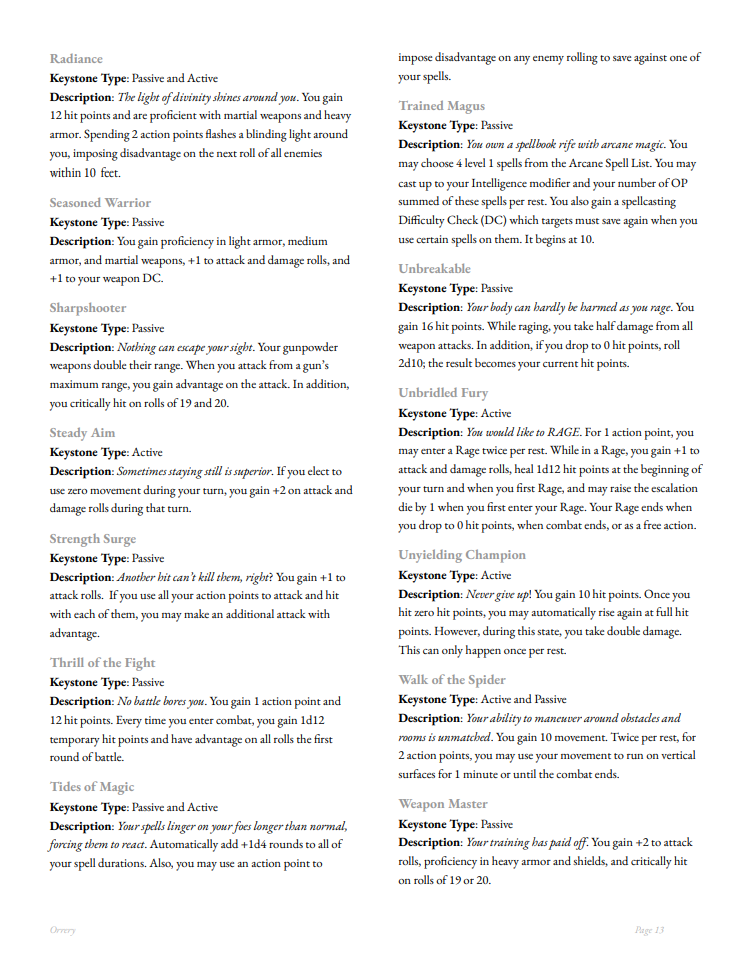
The First Orrery Playtest is Live!

By RJ on 20 January 2023. 


It's here: the first public playtest of my upcoming tabletop roleplaying game, Orrery, is live. 

Inside the first playtest document linger the following game concepts:

  • Core game mechanics and ideas (action points, escalation die, no skills/classes, et cetera).
  • Character creation.
  • Five, fully fleshed out ancestries.
  • Four, in-progress backgrounds.
  • A deep dive into the Orrery itself.
  • Dozens of Orrery keystones.
  • The item system.
  • Three powerful artifacts.
  • Three spell lists (Arcane, Divine, Primal).
  • The swing of combat and action/action points.
  • Various ailments and conditions.
  • The rules on death.

In total, it's 23-pages, not including the extra Prime Orrery sheet.

I'm looking for any and all feedback.

If you would like to test out the system, get a feel for its style, and provide feedback, head on over to the RJD20 Patreon. For $1 per month, you can receive complete access to all Orrery playtest materials: the core book, the Prime Orrery, and the Orrery Bestiary.

Next Friday, I'll be releasing the first full Monster Pack: goblins. In Orrery, many monsters are split into packs, giving a variety of foes to pit against the characters. For example, in the goblin pack, there are grunts, bruisers, commandos, swashbucklers, gorgers, and more! The final Orrery Bestiary will include dozens of packs in addition to solo monsters like the basilisk, dragons, and the phoenix.

The next version of Orrery will likely drop in a month's time, around February 20th. In addition to cleaning up the current rules, it will introduce two new ancestries, fully-fledged backgrounds, a sample Orrery adventure, and a few other secrets.

If you would like to learn more about Orrery before committing to supporting it on Patreon, check out this page about the game or this article announcing its creation. Succinctly, it's a mix of Dungeons & Dragons, Path of Exile, and a few other tabletop roleplaying games I think have compelling mechanics. They're all mixed together with one of my homegrown settings, Golgifell!

Related Articles

Want More RPG Tips & Tales from RJD20?

As always, thanks for reading. Please send all inquiries to rjd20writes@gmail.com or leave a comment below.

Here's to greatening your game and world: cheers!

Do We Want One D&D?

By RJ on 9 January 2023. 


Since writing this article, more has become clear about Wizards of the Coast's intentions with One D&D, monetization, and updated terms with D&D content creators. The rest of this prewritten article explores this, but essentially: refrain from financially supporting Wizards of the Coast. Make your voice heard with money.

Now, onward to the article.

Do We Want One D&D?

As time trudges ever onward and the sixth edition of Dungeons & Dragons, dubbed One D&D, approaches, I've pondered more and more about the necessity of this forever-revamp. Besides Wizards of the Coast, who really desires it?

Generally, the D&D folks who play 5E D&D seemed satisfied with the state of the hobby until WOTC began prepping for One D&D's arrival.

There's a surprising number of people who run older editions as well. The largest group is likely the OSR players. They use a plethora of systems, but all revolve around original or slightly updated D&D.

In the online circles I frequent, not many folks see a need or hold a want for this new ruleset. Again, I've read more opinions of confused, disinterested, or even jaded folk on Reddit, Facebook, and Twitter than people excited for One D&D. Even the One D&D subreddit doesn't seem lively.

At home, the updates puzzle people. Some plan on sticking with 5E D&D. Others already moved to Pathfinder 2E. A few recently became players of the game and are worried everything they purchased and learned will soon become obsolete. Their worry is warranted.

I'm a wanderer myself. Initially, One D&D shocked and excited me. 

Interesting racial abilities? Excellent.

More customization options? Great!

An extremely open development cycle? Lovely.

All appeared positive, but as time has passed, I've grown more skeptical of WOTC's intentions and the system itself.

I'm cautiously pessimistic about One D&D presently.

It's no secret as to why. WOTC has done more than enough to douse my fiery excitement:

  • Driving home the need to monetize D&D for all.
  • Forcing massive mechanical changes.
  • Forcing massive core lore changes or removals.
  • Committing the sin of double speak.

The rest of this article explores each, beginning with the most frightening of all: D&D microtransactions and the unlimited possibilities these will bring.

One D&D and Microtransactions

It's true: the D&D brand and system don't make as much money as they could.

Wizards of the Coast is on the record stating that about 20% of all D&D players are Dungeon Masters. They purchase the most content by far. Non-DM players may pick up one of the player-focused rulebooks like the Player's Handbook, Xanathar's Guide to Everything, or Tasha's Cauldron of Everything, but it's very unlikely they'll buy more.

With a switch to focusing on a virtual experience, this shifts in more ways than one for players and DMs.

There will still be rulebooks, I'm sure, hardcover and PDF, but there will be shiny layers on top. Players will be able to purchase miniatures and cosmetics for them to be used on the virtual tabletop. Perhaps they'll even be able to purchase spell packs that revamp the spell effects. Have you ever wanted an explosion of ice to replace your fireball? How about a big nova of acid? WOTC might sell it. Cosmetics won't be everything a player can get, quite likely. WOTC may venture into selling tiny rules supplements for a low price: new fighter subclasses, a set of new items, a brand-new race or even a slight update or addition to a current one.

Then there's possible further monetization of Dungeon Masters, who usually spend quite a bit already. If everything is built for a virtual tabletop, then the DM will likely need to purchase items to enhance their game. WOTC might sell entire tilesets of cursed crypts, forbidden woods, grave troughs, and dry seas. They could put up monster packs for sale that include virtual miniatures, cool stat block integrations, and ways to manipulate the creatures that wouldn't be possible without buying the pack. Would you like to easily edit a stat block? Here you go, that functionality comes with a monster pack! But worst of all, I think DMs might be subject to a monthly subscription to even access the virtual tabletop. 

Microtransactions and subscriptions, the unholy duo of gaming, especially in the tabletop landscape.

Truly, there's no way to avoid their unceremonious arrival. I also play video games like Path of Exile and Guild Wars 2 and microtransactions make both games a huge sum of money. WOTC would like a slice of the microtransaction pie with One D&D, and I'm certain they'll get it from a certain section of the community.

Others, though, will move on, continue to build their own content, and ignore WOTC's monetization of Dungeons & Dragons.

The Mechanics of One D&D

Initially, I was intrigued by the mechanical updates in the testing phase for One D&D. Not anymore.

The changes are so drastic and untrue to the core of D&D that I've decided to build my own tabletop roleplaying game. If the latest iteration of D&D, something I've always leaped on, isn't something I desire or recognize, why continue following WOTC?

Understand this, though: everything is a playtest right now, nothing is set in stone. I may not like the mechanical changes and additions, but WOTC has not said anything on whether or not they're staying. Now, I'm sure certain aspects are solidified such as the split of classes into four groups (Martial, Mage, Versatile, and Divine), but others like always succeeding on the roll of a 20 and failing on the roll of a 1 are up in the air.

Regardless, between these vast changes and the new language and stance on the lifelong lore established in D&D, you're better off making your own game or finding one that suits your preferences.

Updating or Removing Core D&D Lore

I've read a decent number of articles, blog posts, and threads in addition to about ten videos debating WOTC's current plans for D&D's problematic terms and lore.

It's a large, touchy topic with plenty of intricacies, I understand that. Some pieces of D&D and its world can be removed as the game evolves, of course, but with the constant erratas of the current 5E books, I'm frightened of what might happen with One D&D and the perpetually online nature of the system.

What happens when a few people get upset over a concerning character? Will WOTC remove them from the official product?

Will WOTC defend their vile villains and inane plots? Or will they bend to those offended over them?

How will they react if a group of people claim a particular monster is problematic, then the movement gains steam online? Will they stay or be slain?

All arrows point toward WOTC bending and not defending their game. One idea I point toward is adding the word typical to all monster alignments or changing their alignment entirely in their latest products. Those who use monster books should know each stat block is already of a typical monster, say a red dragon, orc, or flumph, not the red dragon, orc, or flumph. People were quite upset that stat blocks seemed to deem all orcs as evil, even though that's clearly not the case in many settings, including the default D&D setting. Ultimately, it's up to the worldbuilder to form the factions and creatures of their own world: if their orcs are typically evil, that's fine. If their halflings are typically evil, great. If their drow are typically good, sweet! There's no need to be outraged over almost anything in an official WOTC product, but here we are.

If any outrage exists, it grows, WOTC sees it, and it gets changed. This will mount ten times with One D&D, especially if the products exist primarily online.

WOTC and Double Speak

Saying one thing and doing another is a sin committed by many, especially the most powerful in our society. This includes Wizards of the Coast and their parent company, Hasbro.

During the writing of this article, the entire D&D and RPG community imploded due to the leaked release of WOTC's revised open gaming license (OGL) for One D&D and beyond.

For those unaware, the OGL essentially allowed creators to write and sell content for D&D without the need to pay WOTC royalties. It gave people freedom to use ideas like Armor Class and Ability Scores and the quintessential delving into a dungeon to fight a red dragon as a scenario without fear of WOTC coming after them, as the former stewards of D&D, TSR, did so commonly, people often joked that their company's acronym stood for "They Sue Regularly".

With the revised OGL, WOTC and Hasbro seek to disallow creators from making content without the need to pay royalties to the caretakers of the D&D brand by establishing a new, more strict set of rules for One D&D and attempting to nullify the old OGL that has been in place for over two decades.

This all comes after an article released on D&D Beyond by WOTC stating that any change to the OGL only sought to foster D&D creators, prevent corporations from abusing the brand, and create a community more open than ever. This was false, if the leak is true.

Pure double speak.

You can read the leaked OGL and more about it in this Gizmodo article.

In Summary

I'm no longer excited for One D&D. In fact, I've grown quite pessimistic about the next version of D&D. Time to create my own systems and try out other games, methinks. Remember:

  • One D&D will have microtransactions. Do you support this?
  • D&D's core mechanics are likely changing greatly. Change is fine, but how drastic can the changes be before the game is unrecognizable?
  • D&D's lore can be reformed by the community, WOTC bends to anger online. Are you okay with constant errata to books and products?
  • WOTC's and Hasbro's double speak is ridiculous. I won't be patronizing WOTC presently, will you?

Quite the downer article, but it needed to be written. Research for yourself, look around, watch some videos, and think. Do you want One D&D? I don't.

If you enjoyed this article, check out last week's post on keeping your RPG group alive and well.

Here's to greatening your game and world: cheers!

Want More RPG Tips & Tales from RJD20?

As always, thanks for reading. Please send all inquiries to rjd20writes@gmail.com or leave a comment below.